What has particularly stood out to me is Edmond's character before and after his arrest, specifically before his transformation into the Byronic hero that we know and love. He displays three personality traits that endure regardless of which identity he later inhabits: he is intelligent, he is loyal, and he is noble. However, he is still 19 years old. There was an impression I got when reading that Dantès was not fully developed, not as a character, but a a person. In other words, despite the talents and passions that he had, he just hasn't been around that long in the world. Very central to his tragedy is the fact that he loses his life, so to speak, just before he can begin it: he is arrested at his marriage-feast, and just before he is officially named the captain of the Pharon. But, he also has a naïvite when he approaches his interactions with the characters and events that lead to his downfall.

Both because he is too noble and too young, he is completely unable to comprehend the risk in sailing to Porto-Ferrajo, and if/how that may indict him as a Bonapartist agent. This sort of goes into my next point of him assuming good intentions with everyone that he engages with, but this specifically is something that I think shows his age. In all honesty, I am not familiar with the timeline of Napoleon's rise and fall, nor the political climate of France in 1815 or before to properly gauge how much Dantès would have been aware of the gravity of his actions. It's also worth noting that, because Dantès' sense of devotion, I think he would have sailed to Porto-Ferrajo anyways even if he had a better sense of the risks of his actions or the political implications (and above all he probably would have gotten away with it if Danglars wasn't so fucking nosy), because he cares about fulfilling his Captain's last wish. Despite hsi intelligence, it seems as if he is simply not aware in the way that Morrel and Danglars are, of how dangerously political his actions are, especially because he is just so good.
He is also naïve in his dealings with others. He isn't stupid, because he knows that he and Danglars do not like each other, recognizes--and dislikes--that Caderousse is selfish, and undertands that Fernand is a threat. Yet, he could not conceptualize that they would play any part in sabotaging him at all. He is ready to trust Villefort, whom he has just met and believes to be a fair dispenser of justice, to save him. It does not cross his mind that anyone could have ulterior motives in their actions, or that they would simply and effectively kill another man for their own gain. With regards to the Bonapartist plot, it seemed as if it never occured to him that he was being used to further his Captain's political mission from beyond the grave.
All this is to say that Dantès in his youth has barely lived. This deepens the tragedy of his death, which occurs in the dungeons of the Chateau d'If, and leads to the emergence of a new creature that appears to be unmoored from a singular sense of self. Ironically, being sent to prison allowed him to access the wealth of knowledge provided by Faria, an education that would have been beyond the reach or interest of a young Dantés. Although Dantès does not survive, Faria provides him with the resources, by way of his teachings, to adopt the many personages he later inhabits.
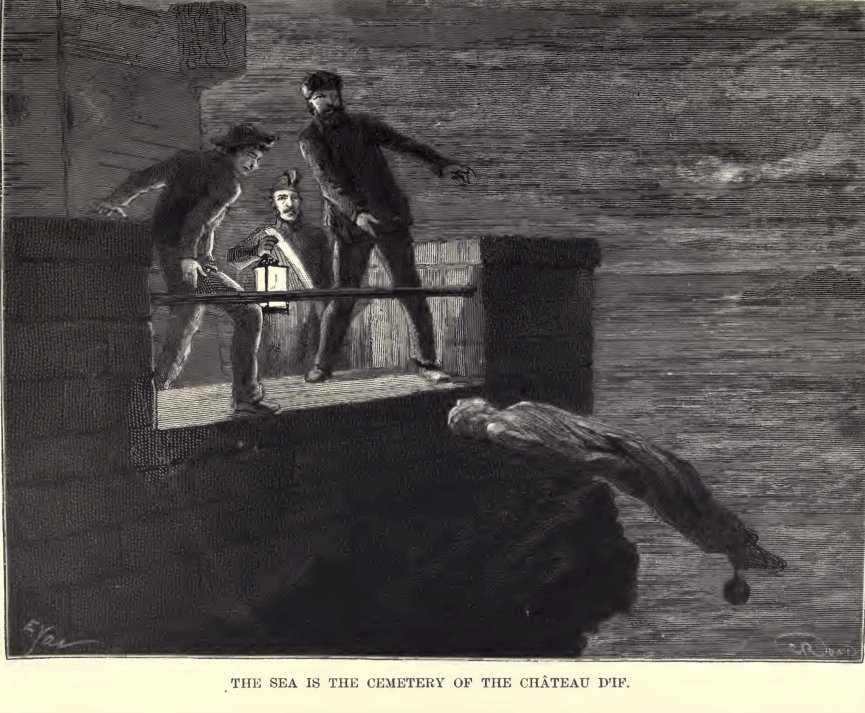
I find it interesting also that, in his escape, the first person that "Dantes" becomes is Faria himself, when he hides himself in his body bag, and is literally thrown into his "grave" which is, symbolically, the ocean. Not only is Dantes killed, but this new person is also baptised by the ocean that he once made his livelihood on, and that would be his domain in the future. Ironically, the innocent prisoner who did not actually commit a crime is well prepared to exact his vengeance against his enemies--the extent of which we do not know of yet.
After the point in which Dantes is rescued by the smugglers, Dumas no longer refers to him by his old name, and instead we get the iconic description of a startling pale figure (much like a corpse. Ugh!) with a strange look in his (sexy, incredibly handsome). There is one exception of course, which is on the island of Monte Christo, where Dantes in disguise as a beloved smuggler actually finds his treasure. After this point, we lose track of Dantes, but are instead treated to very dashing, unnamed figures like "the Abbe" or "the representative of the house of Thompson and French," or the mysterious gentlemen who pulls up to Marseilles in a gorgeous Genoese Yacht and cries in an old apartment. Actually, its a painfully ironic scene where the Mysterious Stranger goes to the house of Dantes' father and finds it occupied by a young couple. Over and over we are reminded of what Dantes was robbed of when he was sent to prison, and what no amount of wealth can undo.
That is kind of going off topic, but I love how at this point, there really is no more Dantes. The boy who was on the verge of marrying his fiancee and becoming captain, and indeed the conditions of the world that created that boy, that were prepared to give him that life, no longer exist. Mercedes is married to Fernand, Dantes' father is dead, Morrel is nearly bankrupt and the Pharon is missing. Marseilles has been abandoned by his "friends" who have all become fabulously wealthy, seemingly because Dantes had died. So, what do we have left? Its hard to say.
The only figure that, at this point, seems to be as real as Dantes was is Sinbad the Sailor. I am VERY excited to learn more about this guy, and how common it is for him to bring rich French twinks into his underground palace to dine and get high with and look at with eyes that betray his lust for vengeance. Or something. I think also that, with the wealth that hes accumulated and his various exploits (plus what SInbad tells Franz), the biggest question is: what will Dantes do once he has achieved his revenge? It seems easy for Sinbad to say that he'll go off and do adventures in Asia and Africa, and very easy for him to talk about a visit to Paris that he will attend to in disguise, but for me, it seems hard to believe that his purpose in life extends, or allows himself to live, beyond he achievement of that endgoal. I suppose that will be addressed in due time, though.
Sun, 21 Dec 2025 15:16:20 +0500